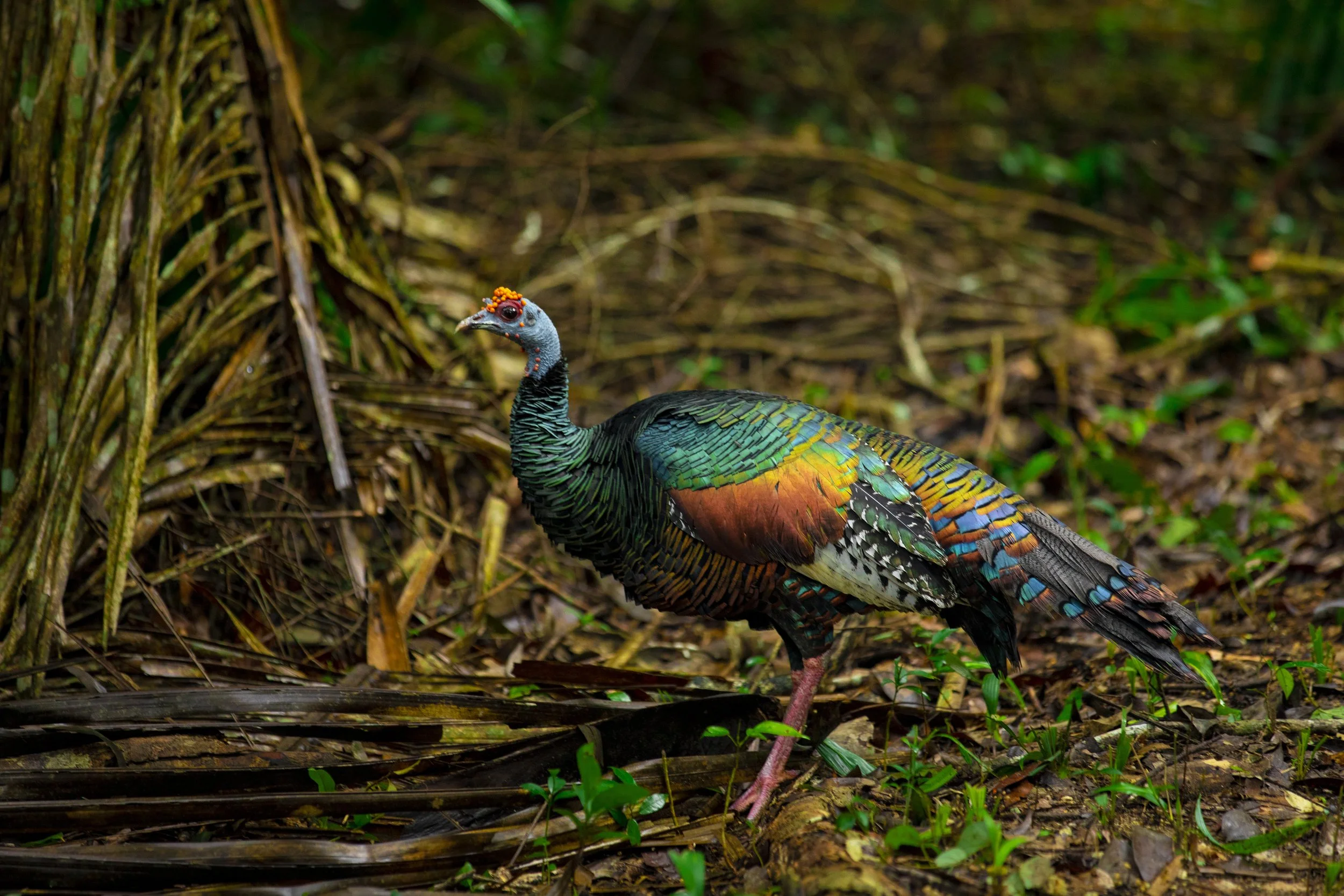
Most birders spend years chasing their target species. At Chan Chich Lodge, this one often walks past the breakfast table.
The Ocellated Turkey is one of the most striking birds in the Americas, and one of the most sought after on any Belize birding trip. It lives in only one small corner of the world, and you won't find it in the US, Canada or Europe. Here is what makes it special, and where and how to see an Ocellated Turkey in Belize.
A turkey unlike any other
Forget the bird on the holiday table. The Ocellated Turkey looks like it was designed by a jeweler.
The feathers shimmer in bronze, green and electric blue, with wings banded in copper and white.
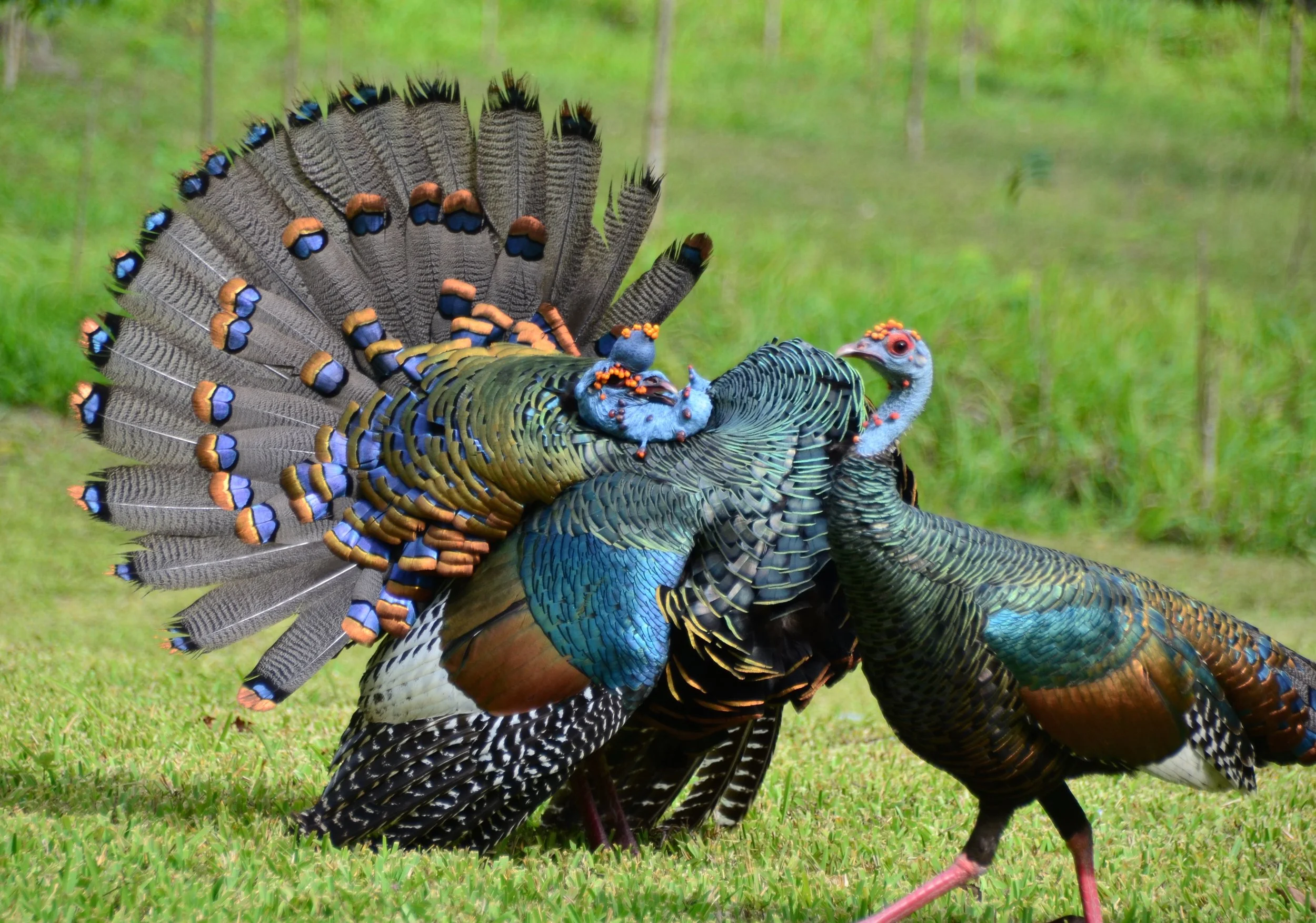
The tail is covered in eye-shaped spots of blue and bronze tipped with gold. These spots, called ocelli, give the bird its name and look a lot like a peacock's.
The head is bare and sky blue, dotted with orange and red bumps. In breeding season, the male's fleshy blue crown swells and turns yellow-orange.
The legs are a deep red.
Males weigh around 11 pounds, and females around 6.6.
Why birders travel for it
The Ocellated Turkey lives only on the Yucatán Peninsula: southeastern Mexico, northern and western Belize, and northern Guatemala. That makes it a true regional specialty, a bird you can only add to your life list by coming here.
It is also a bird with a story. The ancient Maya prized turkeys for their iridescent feathers and leg spurs, and archaeologists have translated one Maya ruler's title as "Great Male Turkey, Shaker of Cities." Chan Chich Lodge sits on the plaza of an ancient Maya city, so the turkeys you see here are walking ground their ancestors shared with the Maya.
Today the species is listed as Near Threatened, with an estimated 20,000 to 50,000 birds left and the number falling. Hunting and the loss of habitat are the main threats. That is why large, protected areas matter so much to its future.
Where to see Ocellated Turkeys in Belize
You need two things to see this bird well: the right habitat, and protection from hunting. Chan Chich Lodge has both.
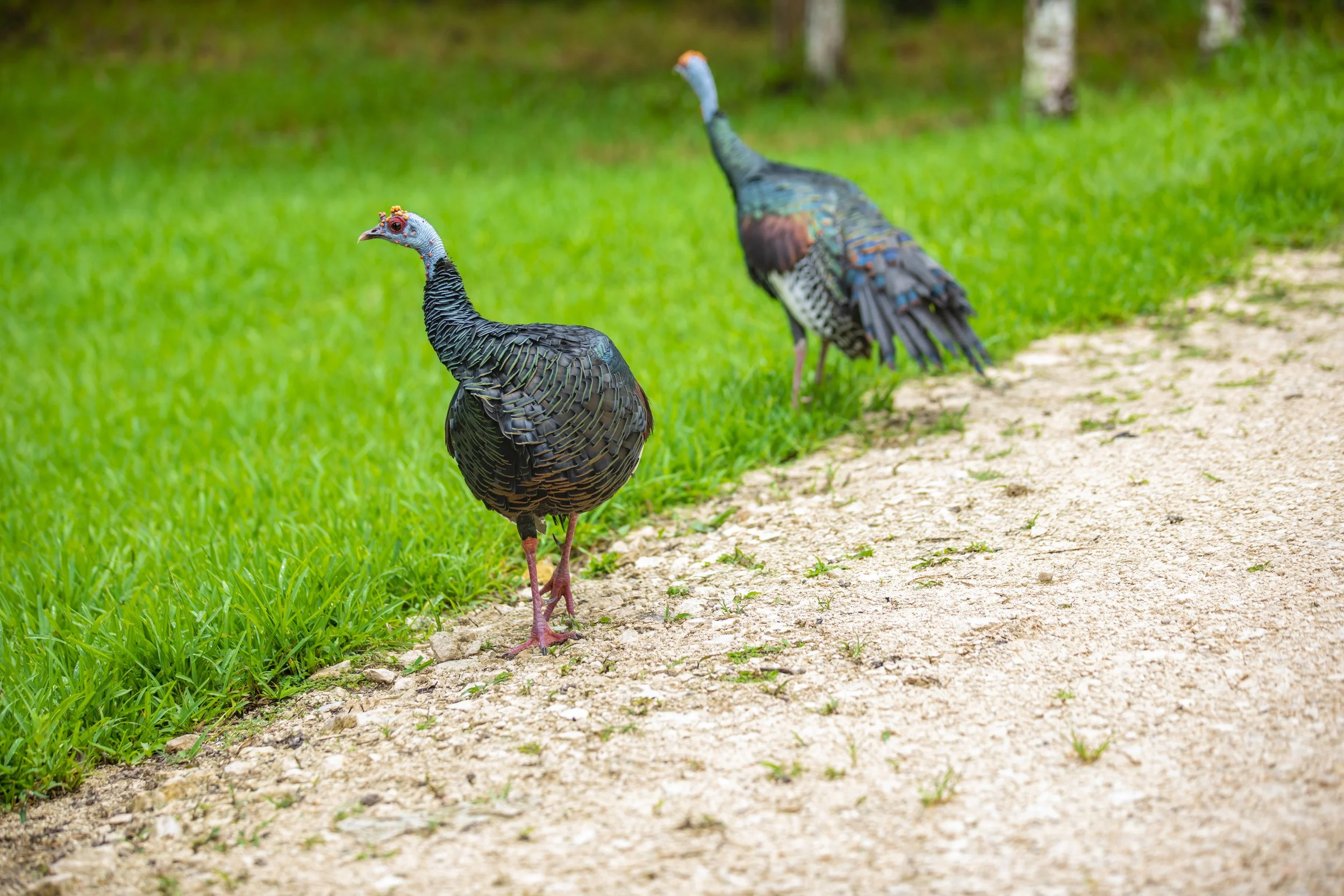
Chan Chich Lodge sits inside a 30,000-acre private reserve, part of roughly 500,000 acres of protected rainforest that stretches across the borders of Belize, Guatemala and Mexico. With no hunting and plenty of cover, the turkeys here are relaxed around people. Instead of slipping away into the undergrowth, they stroll across the lawns and between the cabanas, often just a few feet from guests having breakfast.
Ocellated Turkeys have been recorded at Chan Chich in every month of the year. If you stay a few days, you are very likely to see them. As always with wildlife, we can't promise it, but this is one of the most reliable places we know.
When to see them
You can see Ocellated Turkeys at Chan Chich year round, but each season offers something different.
February to April: breeding season. Males start gobbling in February, and activity peaks in March. This is the time to see males fan their spotted tails, vibrate their wings and strut through groups of hens.
May to July: chicks. Hens lay 8 to 15 eggs in a hidden nest on the ground, and chicks hatch from May through July. The fluffy, reddish-brown chicks leave the nest almost immediately and follow their mother everywhere. It is a lovely reason to visit in the quieter months.
Every morning and late afternoon. The turkeys are most active early and late in the day, and the lodge lawns are a good place to start.
Tips for seeing and photographing them
Start at the lodge. Walk the lawns and the edges of the plaza early in the morning before you head out on the trails, many times they might be right outside your room door.
Move slowly. The birds here are used to people, but they will walk off if you rush toward them.
Use the light. The iridescent feathers change color with the angle of the sun. Soft morning light brings out the blues and bronzes best.
Go low. For photos, crouch to the bird's eye level instead of shooting down at it.
Join a guided walk. Our guides know the birds' habits and can help you find other regional specialties along the trails, from Keel-billed Toucans to raptors.
Log it. Record your sighting on eBird or Merlin. Your record helps track how the species is doing.
More than one bird
The Ocellated Turkey may be the headliner, but it is just one of more than 370 bird species recorded at Chan Chich. Once you've seen it on the lawn, there are more than nine miles of trails waiting. Read about some of the harder-to-find species in Rare Birds of Northern Belize, Recorded at Chan Chich, and see our full birding checklist.
Ocellated Turkey FAQs
Where can you see an Ocellated Turkey? Only on the Yucatán Peninsula: southeastern Mexico, northern and western Belize, and northern Guatemala. In Belize, protected rainforest reserves in the northwest, like Chan Chich Lodge, are among the most reliable places to see them.
Are Ocellated Turkeys endangered? They are listed as Near Threatened, with an estimated 20,000 to 50,000 birds and a falling population. Hunting and habitat loss are the main threats.
What is the best time of year to see Ocellated Turkeys? They are present at Chan Chich all year. February to April is breeding season, when males display, and May to July is when chicks hatch.
Can Ocellated Turkeys fly? Yes. They prefer to run from danger, but they can fly fast over short distances, and they roost high in trees at night.
How is the Ocellated Turkey different from the Wild Turkey? It is smaller, with a bright blue head, iridescent bronze and green feathers, and eye-like spots on its tail. It has no beard, and its call sounds nothing like a classic gobble.
Plan your birding stay
Come for the Ocellated Turkey and stay for the other 370+ species. Tell us your travel dates and the birds on your wish list, and our team will suggest the best time to visit, the right cabana and guided walks to match.